On August 11, 2025, Ethereum ETFs recorded a startling single-day inflow of $1.0 billion, with BlackRock’s iShares Ethereum Trust (ETHA) contributing $640 million of that total—numbers that forced me to stop and re-evaluate the momentum behind ETHA vs BTC ETFs.
The follow-up session kept the pace: ether ETFs added another $523.92 million, with ETHA and Fidelity’s FETH taking large shares, pushing total ether ETF net assets to roughly $27.6 billion. Bitcoin ETFs that same day were quieter, about $65.95 million in inflows, highlighted by BlackRock’s IBIT but offset by outflows from Ark 21Shares and Grayscale.
These flows matter beyond headline totals. Year-to-date inflows into Ethereum ETFs hit $8.2 billion, close to 1.5% of Ethereum’s market cap, while ether’s price rallied toward $4,800—a 26% seven-day gain and more than 50% month-to-date for ETH assets. At the same time, legal scrutiny from New York Attorney General Letitia James added a regulatory backdrop that likely influenced institutional timing and risk appetite.
So the core question I kept returning to while tracking blackrock etha inflows vs btc etfs august 2025 was simple: is this a transient rush into ETH products, or the start of a structural shift in crypto allocation? The data point to a surge led by BlackRock ETHA inflows, but the story threads—market reaction, regulatory pressure, and BTC ETFs August 2025 behavior—are all intertwined.
Key Takeaways
- BlackRock ETHA led a record ether ETF day on Aug 11, 2025, with $640 million of a $1.0 billion inflow.
- Ether ETFs continued strong flows the next session; total ether ETF assets approached $27.6 billion.
- Bitcoin ETFs saw modest inflows in August 2025, driven partly by BlackRock’s IBIT.
- Year-to-date ETH ETF inflows (~$8.2B) represent a meaningful share of ether’s market cap.
- Regulatory scrutiny from NY Attorney General Letitia James added an important risk factor for both ETHA and BTC ETFs.
Overview of BlackRock ETHA and BTC ETFs
I watch flows closely because they reveal where institutions place capital. In mid-August, activity around ether products grabbed my attention. BlackRock’s iShares Ethereum Trust stood out on a few big days, drawing massive purchases that shifted market visibility and AUM figures.
What is BlackRock ETHA? I break it down from my notes. ETHA is an exchange-traded product that gives investors exposure to ether through a regulated wrapper. BlackRock’s distribution muscle and reported institutional buys—one notable trade around 150,000 ETH—helped fuel demand. Those blackrock etha inflows translated into rapid growth in net assets, lifting the total to multi-billion levels by mid-August.
Understanding Bitcoin ETFs requires a slightly different lens. Bitcoin funds like IBIT, ARK 21Shares’ offering, and Grayscale’s GBTC trade as proxies for spot BTC exposure. In mid-August, inflows were mixed. IBIT posted a sizable daily intake while ARKB and GBTC saw outflows, suggesting rotation within bitcoin products. Watching btc etfs as a group helps me sense whether money is chasing BTC or moving between ETF wrappers.
Importance of inflows in investment strategy is something I stress to peers. Inflows vs etfs matter because cash into a fund becomes buying pressure in the underlying market. Strong flows lift AUM, improve liquidity and attract further notice from allocators. Tracking blackrock etha inflows alongside btc etfs gives a clearer picture of institutional preference and short-term supply-demand dynamics.
Historical Inflows: A Comparative Analysis
I track flows closely because they tell a story no press release can match. Looking back, patterns around ether and bitcoin ETFs reveal shifting preferences among institutions and retail alike. Trends in the data explain why some days feel like a turning point.
BlackRock ETHA Inflows Trends
I watched July’s record day of $726.6M, then August 11 pushed demand past $1.0B. Those spikes fed a year-to-date total near $8.2B by August 2025. This rapid rise is part technical, part narrative. BlackRock’s moves and the GENIUS Act chatter nudged allocators toward ETH exposure.
Post-merge supply changes reduced net issuance, so inflows often outpaced fresh ether entering the market. That imbalance made capital flows more meaningful than raw price action for a spell.
BTC ETF Inflows Over Time
Bitcoin ETFs still hold larger cumulative AUM historically, yet daily net flows can be modest by comparison. Mid-August showed net inflows around $65.95M on some days. At the same time, single-product swings happened; BlackRock’s IBIT saw a $111.44M inflow while legacy trusts like GBTC recorded outflows.
These dynamics reflect product maturity and investor preference for broad-market access versus targeted ether exposure. Tracking btc etfs inflows over time highlights episodic concentration into flagship ETFs.
Key Historical Events Impacting Inflows
Certain moments shaped the flow narrative. The Ethereum merge in September 2022 altered issuance and long-term yield expectations. Regulatory shifts, like clearer ETF frameworks, changed how allocators weighed digital assets.
BlackRock’s large reported ether purchases and policy moves such as the GENIUS Act created visible confidence signals. Together, these items fed the patterns labelled blackrock etha inflows history and fed larger market conversations around august 2025 inflows trends.
| Metric | Key Dates | Notable Figures | Impact |
|---|---|---|---|
| Single-day ETH ETF record | August 11, 2025 | $1.0B | Surge in demand; drove media attention and reallocations |
| Single-day BTC ETF notable flows | Mid-August, 2025 | $111.44M (IBIT); $65.95M net on some days | Concentration in flagship products; mixed flows across legacy trusts |
| Year-to-date ETH ETF inflows | Through August 2025 | $8.2B | Strong cumulative demand for ether exposure |
| Ethereum merge | September 2022 | Protocol-level issuance cut | Changed supply economics; shifted investor calculus |
| Policy and institutional signals | 2025–2025 | BlackRock purchases; GENIUS Act attention | Increased confidence and inflow velocity |
August 2025 Market Trends
I watched the market shift in early August and felt the momentum change. Prices moved quickly. That small window showed how flows can swing the narrative for funds and institutions.
Current Market Overview
Ether surged past $4,000 and pushed toward $4,800 in early to mid-August 2025, posting sharp weekly gains near 26% over seven days. Those moves coincided with outsized ETF inflows: a record roughly $1 billion on August 11 and about $523.92 million the next day into an ether product.
Bitcoin hovered near $123,507 with daily gains around 3.47% on the same stretch. BTC ETFs drew modest net inflows close to $66 million that day, a sign of steady demand for bitcoin exposure without the euphoric spikes seen in ether products.
ETH vs. BTC: Investment Sentiment
Institutional appetite tilted toward Ethereum. Corporate treasuries reported buying ETH at roughly twice the rate of BTC in mid-August. That pattern shows why discussions about etha vs btc etfs grabbed headlines.
BTC ETFs remained core holdings for many asset allocators. The flows into flagship funds suggested a preference for diversification and long-term allocation rather than chasing short-term momentum.
Predictions for August 2025 Inflows
Short-term momentum favors continued ETHA inflows through August 2025 market trends, driven by recent record days, clearer regulatory signals, and large institutional buys. I expect daily ether ETF totals to stay elevated while volatility persists.
BTC ETF flows should remain steady, with episodic concentration into major products like IBIT and similar tickers. That pattern fits a cautious allocation approach: steady accumulation for bitcoin, tactical surges for ether.
| Metric | Ether (ETHA) | Bitcoin (BTC ETFs) |
|---|---|---|
| Price Range (early–mid Aug) | $4,000 → $4,800 | $123,507 (approx) |
| Notable Daily Inflows | $1,000,000,000 (Aug 11); $523,920,000 (Aug 12) | $66,000,000 (mid-Aug typical day) |
| Seven-day Price Move | ~26% gain | ~3–5% daily moves typical |
| Institutional Behavior | Corporate treasuries buying ETH at ~2x BTC rate | Used for diversified, long-term exposure |
| Short-term Flow Outlook | Continued elevated inflows likely | Steady inflows with episodic concentration |
| Risks | High volatility and mean reversion | Slower reaction to momentum, regulatory shifts |
Graphical Representation of Inflows
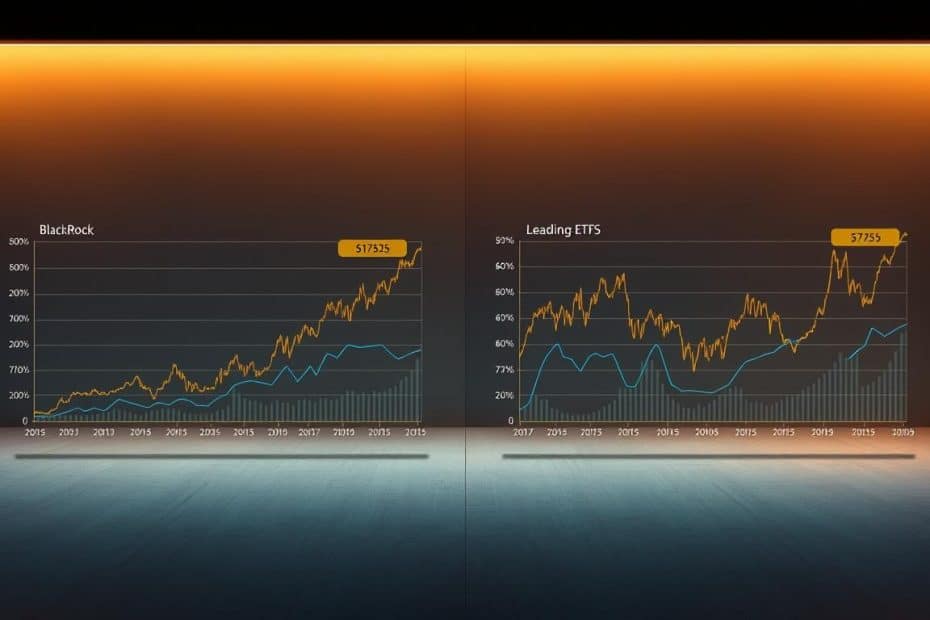
I walk readers through the visual story behind the cash movements. Charts make patterns obvious. A focused inflow metrics graph and a clear blackrock etha inflows vs btc etfs august 2025 chart reveal timing, size, and fund-level drivers.
Inflow Metrics: A Visual Analysis
Daily points matter. On Aug 11, ETH ETF inflows hit $1.0B with BlackRock ETHA at $640M, Fidelity FETH at $277M, and Grayscale near $80M. The next day total ETH ETF inflows fell to $523.92M with ETHA at $318.67M and FETH at $144.93M. Year-to-date cumulative ETH inflows sit around $8.2B while net assets total roughly $27.6B. A single-day BTC example shows $65.95M net flows, where IBIT posted $111.44M but ARKB and GBTC offset with -$23.86M and -$21.63M, and BTC AUM remained near $155.02B.
Plotting these numbers on time-series charts highlights spikes and retractions. A stacked-bar view by fund shows how ETHA dominates spikes. A cumulative AUM line gives scale context versus BTC assets. The blackrock etha inflows vs btc etfs august 2025 chart should place ETH daily spikes above typical BTC flows around mid-August while showing BTC total assets much larger.
Graph Interpretation: Key Takeaways
Visuals emphasize concentration risk when one fund drives a surge. The inflow metrics graph makes it easy to spot single-day anomalies and cluster events. Stacked bars reveal which issuers contributed most during spikes.
Graphical inflow analysis also clarifies scale differences. BTC maintains far higher assets under management, even when ETH flows spike. Combining daily flow series with a cumulative AUM line helps readers see momentum shifts, potential correlations with price moves, and where liquidity is concentrated.
I recommend three chart types for clarity: daily time-series for flows, stacked fund bars for contributor breakdown, and a cumulative AUM overlay for context. Those visuals let investors judge momentum, concentration risk, and short-term correlations quickly.
Statistical Insights: What the Numbers Say
I walk through the recent inflow and price data to give a clean, number-first view. Numbers matter here. They let us build scenarios without hype. I share raw figures and model-ready notes so readers can test their own assumptions.
Percentage Growth of ETHA vs BTC ETFs
ETH ETFs recorded a striking single-day inflow of $1.0B, followed by $523.92M the next notable session. That surge coincided with an approximate seven-day ETH price gain near 26% and a month-to-date rise above 50%.
On the same reporting day, BTC ETFs netted $65.95M while trading volume for BTC funds hit roughly $3.05B. BTC spot hovered near $123,507 with a daily move of +3.47%; ETH was near $4,724 with +3.15%.
When I compare percentage growth etha vs btc across these windows, ETHA inflows show concentrated spikes that produce outsized short-term gains in percentage terms. BTC inflows appear steadier with smaller single-day percentage moves but larger cumulative AUM.
Volatility Analysis
Volatility analysis ether bitcoin points to stronger short-term swings for ETH tied to ETF entry events. Large ETHA inflows map to sharp price moves within 24–72 hours.
BTC exhibits lower intraday volatility around ETF flows, yet it still reacts to net inflows and high trading volume. The $3.05B trade day illustrates how liquidity can dampen or amplify short-term moves depending on execution and market depth.
Long-term Projections
My long-term projections august 2025 scenarios rest on two pillars: continued institutional adoption and steady regulatory clarity. If institutions keep buying ETH at higher rates, ETHA inflows could maintain a material share of demand.
The larger BTC ETF ecosystem, with its cumulative AUM advantage, positions BTC to stay a dominant store-of-value allocation even as ETH grows its ETF footprint. I include these figures because they form the backbone for model-based scenario testing.
| Metric | ETH / ETHA | BTC / BTC ETFs |
|---|---|---|
| Notable single-day inflow | $1.0B | $65.95M |
| Follow-up large inflow | $523.92M | — |
| Recent seven-day price change | ~26% | ~3.47% (daily context) |
| Month-to-date price change | >50% | varies by period |
| Reported daily trading volume (ETF products) | lower than BTC, spiking on inflow days | $3.05B |
| YTD ETF inflows | $8.2B | substantial cumulative inflows; higher AUM |
| Market-cap share from inflows | ~1.5% of ETH market cap | smaller percent impact due to larger market cap |
Influencing Factors Behind Inflows
I’ve been watching fund flows closely. Small signals stack into big moves. Institutional moves, rules and day-to-day sentiment all shape how capital shifts between products.
Institutional drivers matter. BlackRock’s 150,000 ETH purchase and rising corporate treasury allocations pushed demand for Ethereum exposure. When big names such as BlackRock, Fidelity, and Grayscale dominate flows, product design and custody features become decisive. Easy ETF access and competitive fee schedules drew predictable allocations toward ETH-linked instruments.
I remember two consecutive days of outsized inflows into ETH listings. Those bursts signaled interest beyond retail traders. At the same time, institutional rotation favored ETFs with deeper liquidity and lower fees, producing concentrated flows into certain Bitcoin vehicles while leaving legacy products lighter.
Regulatory shifts shape trust and risk appetite. Passage of clearer frameworks for stablecoins under national legislation reassured some asset managers, indirectly supporting interest in Ethereum-linked funds. High-profile enforcement actions in New York highlighted continuing legal risks that can dampen appetite and slow new launches.
Regulatory tone affects channeling of capital. Firms weigh compliance costs against potential returns. When rules look predictable, more institutions consider allocation increases. If enforcement headlines rise, flows can stall or migrate to perceived safer wrappers.
Daily market mood guides timing and sizing of inflows. Two large inflow days turned sentiment into momentum for ETH funds this summer. Product-level preferences emerged for Bitcoin ETFs, with inflows concentrating in new, efficient offerings while older funds saw outflows.
Short-term sentiment and longer-term allocation choices interact. Traders react to headlines and order books. Chief investment officers respond to balance sheet targets. That push-pull creates windows of opportunity where inflows accelerate or reverse.
The interplay of institutional adoption etha, regulatory developments btc etfs, and market sentiment august 2025 produces moving parts. Each factor nudges flows; together they create the patterns I track when advising portfolio adjustments.
Tools for Investors
I keep a short toolkit for monitoring ETF flows and prices. It blends daily trackers, charting platforms, and simple risk tests. This setup helps me react to single-fund shocks without overtrading.
Start with established data sources. I watch Bloomberg Intelligence for ETF flow notes and Eric Balchunas’ commentary. TradingView and CoinGecko give clean time-series prices. Yahoo Finance and BraveNewCoin fill gaps in fund-level numbers.
Top Analytics Platforms for Tracking Inflows
Pick a mix of general and crypto-focused tools. TradingView handles chart overlays and correlation studies. CoinGecko covers spot liquidity and volumes. Bloomberg and Yahoo Finance publish ETF flow summaries and AUM updates.
For specialized reads, use BraveNewCoin and Bitcoin.com News reporting for narrative context. These sources make it easier to spot structural changes fast. I use alerts for large net inflows into IBIT and ETHA.
Using Charts for Informed Decisions
Time-series inflow trackers are essential. I plot stacked fund-level flows alongside price charts. That reveals whether flows lead or lag prices.
Correlation matrices help. I compare ETF flows to spot returns for ETH and BTC. This shows when flows are directional or just rebalancing.
Evaluating Investment Risks
Risk checks must be simple and repeatable. I watch concentration risk when ETHA dominates ETF inflows. I monitor regulatory headlines that affect BTC ETFs, such as state actions and legislative shifts.
Run scenario stress tests. Use position-sizing rules and liquidity screens for smaller products. These steps help me evaluate investment risks eth btc without getting lost in noise.
| Tool | Main Use | Strength | How I Use It |
|---|---|---|---|
| Bloomberg Intelligence | ETF flow reports and analyst notes | Institutional-grade data | Daily scan for major fund inflows and AUM shifts |
| TradingView | Charting and correlation matrices | Custom overlays and alerts | Plot stacked fund flows vs price; set alerts for large volume spikes |
| CoinGecko | Spot prices, volumes, liquidity | Realtime crypto metrics | Compare spot liquidity to ETF inflows to detect price pressure |
| Yahoo Finance | ETF summaries and flow snapshots | Accessible fund-level data | Cross-check daily flow numbers and AUM for IBIT, ETHA |
| BraveNewCoin / Bitcoin.com | Crypto market commentary | Context and narrative | Use for headlines that may shift sentiment and inflows |
Case Studies: Success Stories
I walk through three real episodes where fund design and execution shaped outcomes. These short case studies show how focused product management and market trust can move capital and prices. I keep the examples tight so you can apply the ideas to your own analysis.
Notable Miracles: ETHA Strategies
BlackRock’s ETHA captured attention with rapid accumulation periods, including a reported $640M single-day capture that coincided with strategic ETH buys. Institutional stewardship and broad distribution amplified inflows. That activity helped push ether toward a near-term peak around $4,800, showing how product-level moves can influence on-chain prices.
BTC ETF Thriving Instances
On a day when many bitcoin products saw outflows, BlackRock’s IBIT recorded $111.44M of inflows. That event illustrated a btc etf case study in which brand trust and placement consolidate demand. Large aggregate AUM for bitcoin ETFs—reported near $155.02B on a notable day—speaks to sustained investor confidence and the ability of leading funds to weather rotations.
Lessons Learned from Past Investments
One clear lesson: a single product’s leadership matters. Fee structure, liquidity, custody, and institutional relationships shape distribution success. Product clarity and operational strength often determine whether flows stick or fade.
Regulatory clarity plays a gating role. Where rules are certain, flows scale faster. Uncertainty slows allocations and raises the threshold for large institutional bets.
To summarize practical takeaways, I mapped key contrasts in the table below so readers can see how design and execution differ across winners.
| Case | Driver | Key Metric | Outcome |
|---|---|---|---|
| BlackRock ETHA accumulation | Strategic ETH purchases, broad distribution | $640M single-day capture; ETH price surge to ~$4,800 | Rapid inflows, price momentum, heightened attention |
| IBIT inflow day | Brand trust, placement during outflows | $111.44M net inflow; BTC ETFs AUM ~ $155.02B | Demand consolidation, resilience during rotation |
| Product-level factors | Fees, custody, liquidity, institutional ties | Comparative fee spreads and market depth metrics | Determinant of sustained inflows vs. short-lived spikes |
| Regulatory environment | Clarity vs. uncertainty | Approval timelines and guidance updates | Accelerated allocations or withheld capital |
FAQs: Common Questions Answered
I get asked the same three questions a lot when I review fund flows and market moves. I’ll answer them from my own notes and observations from mid-August 2025, using clear examples from BlackRock and other major managers.
What does ETHA stand for?
ETHA refers to BlackRock’s iShares Ethereum Trust, a spot-based vehicle that gives investors direct price exposure to ETH without requiring each buyer to hold the underlying coins. I watched ETHA absorb a large share of mid-August inflows, making it the largest single recipient that week. The design reduces custody work for retail and institutions, while channeling capital directly into market demand.
How do BTC ETFs work?
BTC ETFs operate as exchange-traded funds that track bitcoin’s price through spot holdings or backed mechanisms. Big examples in August 2025 include BlackRock’s IBIT, Ark 21Shares’ ARKB, and Grayscale’s GBTC, which behaved differently during the same period. ETFs hold either actual bitcoin or arrangements that replicate spot performance, then issue shares that trade like stocks. This structure makes it easier for institutions to gain exposure without managing wallets.
Why are inflows crucial to investment analysis?
Inflows increase an ETF’s assets under management, which can create buying pressure on the underlying asset and shift market sentiment. In mid-August 2025, ETH ETF inflows exceeded post-merge issuance and had a material impact on ETH pricing. Tracking inflows gives a forward-looking signal about allocation trends among large investors and helps explain short-term price moves.
| Question | Short Answer | Real-world Example (Aug 2025) |
|---|---|---|
| what does ethA stand for | iShares Ethereum Trust, spot ETH exposure | Largest single mid-August inflow recipient, simplified custody |
| how btc etfs work | Track bitcoin price via spot holdings or backed mechanisms | IBIT and ARKB gained flows; GBTC still saw outflows |
| why inflows matter august 2025 | Raise AUM, create buying pressure, signal allocation shifts | ETH inflows exceeded issuance and influenced price moves |
Expert Opinions and Predictions
I watch market chatter closely. Analysts from Bloomberg Intelligence, asset managers and independent outlets weigh in on how inflows behave. Their observations shape short-term moves and longer bets. I summarize key viewpoints and what they mean for investors.
Insights from Industry Analysts
Eric Balchunas at Bloomberg Intelligence noted that rising ETH prices plus easier ETF access can create self-reinforcing demand. BlackRock’s early ETH buys and clearer guidance under the GENIUS Act have been read as signatures of institutional confidence. Bitcoin.com News and Sosovalue reported mid‑August inflows as another signal that large investors are warming to ETH exposure.
Predictions for Market Trends
Market strategists I follow expect continued rotation between products. Some predict that inflows will ebb and flow with macro headlines and regulatory updates. My reading of expert opinions etha btc suggests that if regulators remain predictable, spot ETH ETFs could see steady interest through late summer.
Long-term Potential of ETHA vs BTC ETFs
Long-term scenarios split along use case lines. Institutions chasing store-of-value tend to stick with BTC ETFs, given huge AUM and entrenched demand. Corporates that adopt ETH for treasury or application exposure may expand allocations faster.
Models I examine point to a market where both asset classes coexist. The long-term potential etha vs btc etfs depends on corporate treasuries, continued spot inflows, and regulatory clarity. If those elements persist, ETH ETFs can capture growing share without displacing Bitcoin’s core role.
Analyst sentiment includes measured optimism and caution. My takeaway from predictions august 2025 is that momentum will hinge on a few clear signals: consistent inflows, policy steadiness, and visible corporate allocations. That combination would sustain institutional appetite for both products.
Conclusion: The Future of Inflows
August 2025 marked a clear structural inflection in ETF flows. A record single-day inflow on August 11 and follow-up days showed that Ethereum-backed ETFs, led by BlackRock’s ETHA, captured concentrated capital while spot Bitcoin ETFs saw steadier, smaller slices. ETH ETF net assets pushed toward $27.6 billion as Ether climbed near $4,800, and BlackRock’s institutional purchases added tangible weight to market confidence.
Final thoughts blackrock etha inflows vs btc etfs august 2025: the data points to a regime where fund-level concentration matters. ETHA accounted for the lion’s share of large inflow days ($640M and $318.67M contributions), while IBIT and other Bitcoin funds had meaningful but more dispersed activity. Regulatory headlines, from the GENIUS Act to scrutiny by the New York Attorney General, remain a watchpoint that can flip sentiment quickly.
For DIY readers, treat the conclusion inflows august 2025 as a starting signal, not a green light to overweight immediately. Track flow aggregators, monitor AUM growth, and watch fund-level concentration. My practical call to action investors etf inflows: build scenarios, size positions conservatively, and wait for consistent evidence across multiple days and clearer regulatory signals before reallocating material capital.